Aiden, I have managed to double book myself and Vicky once more on Monday morning!!!! We have a large group meeting at 10 with the set design group that is vital for final design approvals. Can we meet up later on Monday or I could do Wednesday afternoon from 1pm for the final two slides and a reading run through.
Kick me!!!!!
Fiona
Sunday, 27 March 2011

some images for the group by Aidan Codd


All images were sacand in from book Untited.2 The beautiful renaissance ( carpet bombing culture - 2008 )
Saturday, 26 March 2011
@group
Thursdays meeting-
Present, Fiona, Aidan and Vicky.
Re-cap: started powerpoint presentaion, taking inforation from the blog and arranging on slides.
deciding which information from the blog should be put into the presentation and cutting it down so hopefully we dont get gongged out :).
NEXT MEETING: Monday 28th @ 10am in library.
To finish powerpoint an run through what we are saying.
Present, Fiona, Aidan and Vicky.
Re-cap: started powerpoint presentaion, taking inforation from the blog and arranging on slides.
deciding which information from the blog should be put into the presentation and cutting it down so hopefully we dont get gongged out :).
NEXT MEETING: Monday 28th @ 10am in library.
To finish powerpoint an run through what we are saying.
Thursday, 24 March 2011
Images of 2010 Student Riots
 www.spector.co.uk/melaniephillips/6459290/rough-beast-slouches-police-force-couches.thtml
 www.hizb.org.uk/year-in-review/2010/students-riot-as-they-are-swindled-by-the-liberals-who-promised-to-vote-against-a-rise-in-tuition-fees-exposing-democracy%E2%80%99s-hypocrisy


Dada, Situationists and Surrealism
 |
| The Fountain - Duchamp ready made |
 |
| Duchamps alter-ego Rose Selavy |
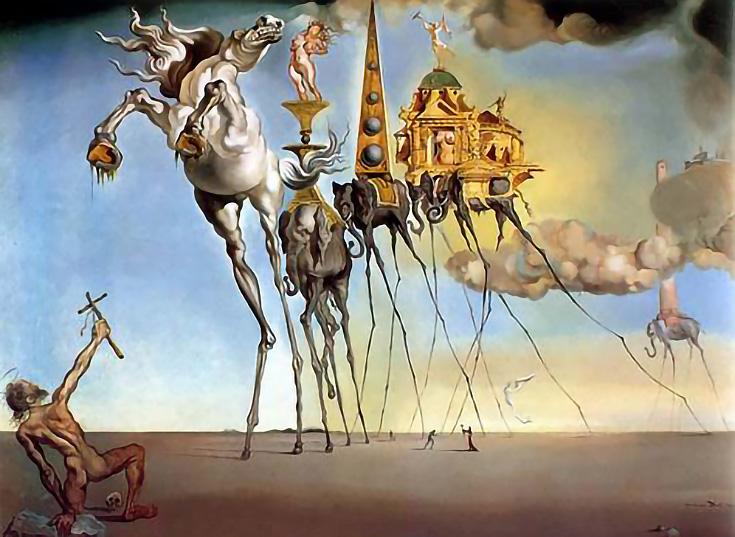
Surrealists (1920- 1930's) acknowledged the spontaneous creation lauded by Dadaism but removed themselves from their ironic anti-art position. They embraced new ideas from Sigmund Freud such as the importance of dreams and the subconcious. Automatism - thought uninterrupted by rational control - was key to the surrealists who believed that rational thought was at fault for the worlds problems and change could only come about through the subconcious mind.
 |
| Picture by Dali - The temptations of St Anthony http://emptyeasel.com/wp-content/uploads/2007/10/thetemptationofstanthonybysalvadordali.jpg |
Situationists grew out of Dadaism and Surrealism, they wanted to break down the barriers between art, politics and other forms of social oppression. Encouraging people to adorn the streets with statements such as 'Free the Passions' and 'Never Work', their sloganeering was closely linked to the Paris student riots in 1968. They inspired people to rework metro posters (an early version of subvertising) challenging the ideas of ownership and creativity, believing if you wanted to put art on the streets you should do it, if you disagreed with an advert you should rework it, action here and now to transform everyday life.
Bibliography:
Lewisohn, Cedar: Street Art (2008) Tate publishing, London
Peiter, Sebastian: Guerilla Art (2009) Laurence King Publishing Ltd, London
Untitled II The Beautiful Renaissance (2009) Pro-Actif Communications, Durham
Brassai - Graffiti
The wall,
Botticelli, who loathed landscapes, said one day that "by merely throwing a sponge soaked in a variety of colours at a wall it would leave a stain in which could be seen a beautiful landscape". (Leonardo da Vinci quoting the artist in his book Treatise on Painting).
His words are almost prophetic, graffiti and street art ignored and ridiculed at the beginning of the 20th century has now made its way into galleries and museums - in a single generation they have been transformed into prestigious works of art in their own right.
This would not have been possible without the forerunners of modern artists such as Picasso, Gauguin and Van Gogh with their love for the simple, childlike and tribal art and their desire to begin anew and look at the world through new eyes. Indeed Brassai was a contemporary of these artists and his pictures would have been discussed among them, he believed that graffiti was a pure art form in who's simplicity he found a stunning modernity. In the foreword to the book Brassai: Graffiti, Gilberte Brassai states:
safe haven for what is forbidden, gives a voice to all those who would, without it,
be condemned to silence
(Poem by Brassai)
(Poem by Brassai)
Botticelli, who loathed landscapes, said one day that "by merely throwing a sponge soaked in a variety of colours at a wall it would leave a stain in which could be seen a beautiful landscape". (Leonardo da Vinci quoting the artist in his book Treatise on Painting).
His words are almost prophetic, graffiti and street art ignored and ridiculed at the beginning of the 20th century has now made its way into galleries and museums - in a single generation they have been transformed into prestigious works of art in their own right.
This would not have been possible without the forerunners of modern artists such as Picasso, Gauguin and Van Gogh with their love for the simple, childlike and tribal art and their desire to begin anew and look at the world through new eyes. Indeed Brassai was a contemporary of these artists and his pictures would have been discussed among them, he believed that graffiti was a pure art form in who's simplicity he found a stunning modernity. In the foreword to the book Brassai: Graffiti, Gilberte Brassai states:
Picasso too saw great worth in the study of graffiti and often copied it when he was young. Brassai kept details of his discussions with Picasso and this extract from Wednedsay, November 27, 1946 gives an idea of how excited he was by them:"Brassai was convinced that these manifestations "of so little importance," were in fact an emination of the dream world, a true essence of reality."
(Brassai has just given him some photographs of his latest series of graffiti) "These graffiti are really astonishing! What phenomenal inventiveness you find in them sometimes. When I see kids drawing in the street, on the pavement or the wall, I will always stop to look. It's surprising what comes out of their hands. They often teach me something." (Graffiti:137)
Brassai: Graffiti (2002) Flammarion, France
Images from Brassai Graffit


Subscribe to:
Posts (Atom)